
🟠 Percepio DevAlert
Get cloud-based observability on anomalies in edge devices and embedded software. Detect and analyse issues remotely, during testing and in deployed devices. Use your familiar desktop tools for secure remote debugging.
Release sooner
Solve elusive bugs during system
testing by deep observability into the
software, with easy remote access
for all team members.
De-Risk Product Launch
Testing does not find all bugs and
vulnerabilities. Detect issues in
customer devices, understand the
cause and provide rapid solutions.
Efficient Technical Support
Increase first contact resolution. Like
diagnostic trouble codes in cars, but
for any product and with remote
access.

Cloud-connected Remote Debugging
Debug remotely and securely without
needing to expose a physical debug port.
For Online Devices
Automatic alerts from device to cloud,
visible in DevAlert within seconds.
Customize and Extend
Create custom alerts on any condition,
with any device data, for any desktop
tool.
Source-code Debugging and System
Tracing
Inspect core dumps from remote devices in your favorite debugger. Capture traces for Tracealyzer.
For Offline Devices
Upload the data via a host device, or store alerts on the device for later retrieval.
Data Control and Privacy
Use your own private data storage and
maintain full control over the diagnostic data.
Deep Observability
DevAlert lets your devices provide automatic alerts on when errors are detected, including core dumps and traces that helps explain the problem. Define your own alerts and include any device data of relevance, for example logs or sensor readings. Everything is easily accessible from the DevAlert dashboard in your web browser.
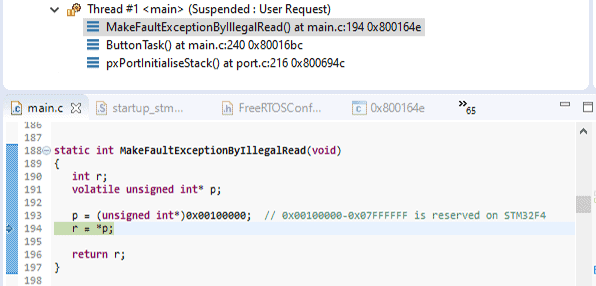
Show core dumps from a remote device with a single click in the dashboard. Hook in your regular source code debugger and getthe same familiar experience as if debugging a local device on your desk. Inspect the call stack, function arguments, variables,registers and more.
Collect system traces for Percepio Tracealyzer and see the software events just before the anomaly was detected, includingRTOS task execution, traced API calls and custom application logging. This helps you understand the circumstances of the error.
Alerts are small (kilobytes or less) and can thereby be stored or uploaded quickly. The device can then resume operation, orrestart if needed, without any noticeable delay.

On Software Issues

IDespite extensive testing there is no way of telling if all bugs have been found,and typically that's not the case. Many edge/embedded devices are developed innative C/C++ code that is prone to elusive bugs. Especially when using RTOSplatforms and multitasking.
DevAlert lets you capture runtime errors automatically, in full detail, and providesemail notifications on new issues. This ensures that you notice the issue on thevery first occurrence and quickly understand the problem, without first having toreproduce the issue in the lab. This minimizes debugging time and is crucial forresolving issues in deployed devices.
If combined with over-the-air software updates, you can rapidly stabilize yoursoftware in deployed devices by providing proactive updates, before manycustomers have been affected.
On Physical Malfunctions
Anomalies in the physical world are often observable from software, for example a dislodged connector resulting in a software error code, or a sensor reporting an abnormal value. In the automotive world these are provided as DTCs, Diagnostic Trouble Codes. DevAlert can provide a custom "DTC" solution for your product, with remote cloud-based access and deep observability when needed.
IDespite extensive testing there is no way of telling if all bugs have been found,and typically that's not the case. Many edge/embedded devices are developed innative C/C++ code that is prone to elusive bugs. Especially when using RTOSplatforms and multitasking.
DevAlert lets you capture runtime errors automatically, in full detail, and providesemail notifications on new issues. This ensures that you notice the issue on thevery first occurrence and quickly understand the problem, without first having toreproduce the issue in the lab. This minimizes debugging time and is crucial forresolving issues in deployed devices.
If combined with over-the-air software updates, you can rapidly stabilize yoursoftware in deployed devices by providing proactive updates, before manycustomers have been affected.

On Cybersecurity Anomalies

Edge devices are often prime targets for cyberattacks due to weaker security and many attack surfaces accessible to the public, such as UARTs, USB and radio protocols. They can be used to gain access to the wider corporate network. All it takes is a single compromised device.
DevAlert offers a platform for cybersecurity anomaly detection by making it easy to report suspicious events from your device software. The deep observability offered by DevAlert lets you determine if the anomaly was caused by an attack or by an accidental error. This can reveal zero-day vulnerabilities, attacks and intrusions within seconds, enabling rapid mitigation and accurate cyber forensics.
Desktop Integration
DevAlert is a hybrid device/cloud/desktop solution where advanced debugging is provided by desktop tools such as GDB and Tracealyzer on your local computer. This way, you don't need to learn a new interface but can leverage familiar tools to analyze data from remote devices. This also makes DevAlert very extendable as you can add custom payload types and map them to any appropriate desktop tool. For example a source-code debugger for viewing core dumps, a text editor for viewing log files, or Tracealyzer for viewing system traces.
This approach is enabled by the Dispatcher tool, a DevAlert client that runs on your local computer. This connects the cloud parts with your desktop tools for a smooth workflow. You simply click the links in the dashboard, and the device data show up in the appropriate tool according to your Dispatcher setup. This combines the convenience of a fully managed cloud service with the privacy, data control and extendibility of local data processing.
Data Control and Privacy
Unlike other cloud-based observability solutions, DevAlert does not consume or
store sensitive device data like firmware images, core dumps, logs and traces
inside the hosted cloud service.
Such data remain in your own private storage at all times where you are in full
control. This can be for example an S3 bucket in your own AWS account, or a
backend server that is already used by your devices. This is separated and
isolated from the hosted DevAlert cloud service, but the data is still easily
accessible from the DevAlert dashboard due to the novel desktop integration via
the Dispatcher tool.

What People are saying
Watch the interview with Sensorbee about their use of DevAlert

It's very important for us to deliver new functionality quickly, from a customer request all the way out to the field. DevAlert helps us accelerate the growth of the company as we can
deliver new functionality faster and
with the high quality expected by our
customers.
David Löwenbrand
CEO, Sensorbee
The world has been waiting for a
solution like DevAlert. DevAlert will
revolutionize product quality and it's a must-have for any embedded or loT
project.
Jacob Beningo
Beningo Embedded Group
DevAlert pushes data about problems to the cloud. Importantly, it
characterizes each event so the
developers are not overwhelmed with multiple reports of identical bugs. As one who has had to fly around the world carrying heavy debugging tools, the idea of getting the info you need to your desk sure is appealing.
Jack Ganssle
The Ganssle Group / Embedded Muse
Services & Support
Evaluation Software
NEWSLETTER & Training
© 2026 Carnica Technology. All Rights Reserved. Contact Us · Legal & Privacy